About Benjamin Hayt
Benjamin Hayt is a Miami-based graduate researcher at the National Aplysia Resource at the University of Miami. His current work focuses on establishing primary cell cultures from Aplysia somatic tissue and embryos to study the cytopathic effects of Aplysia abyssovirus.
His responsibilities include cell isolation, culture, characterization, and cytopathic-effect assessment through viral-exposure assays. The project is ongoing and aims to improve understanding of the virus and support future research using Aplysia as a model organism.
Read more about Benjamin Hayt’s Aplysia cell culture research, including the research question and his role in the project.
Aquatic Systems Design
Outside the laboratory, Benjamin has extensive experience designing and maintaining advanced aquatic life-support systems. His work integrates mechanical filtration, biological cycling, and hydraulic control into cohesive, self-regulating environments.
Among his most distinctive projects is the design of a mechanically driven drum filtration system powered entirely by household tap-water pressure. Unlike conventional drum filters that rely on electric motors, sensors, and automated control boards, his system uses a water piston and float-valve mechanism to initiate and complete cleaning cycles. The design eliminates the need for electrical infrastructure while maintaining reliable particulate removal.
This approach reflects both mechanical creativity and practical systems thinking. By harnessing constant municipal water pressure as a motive force, the filter operates with reduced failure points, lower maintenance demands, and improved operational resilience. The simplicity of the mechanism is part of its innovation: rather than adding complexity, the system achieves functionality through controlled hydraulic sequencing.
A Passion for Japanese Koi
Ben Hayt is widely recognized for long-running involvement in high-value Japanese koi acquisition and development. A frequent participant in international Japanese koi auctions, he has extensive knowledge of bloodline evaluation, genetic potential, growth forecasting, and market valuation. Benjamin’s acquisitions have achieved competitive success at major venues, including the All-Japan Koi Show (AJKS). He also received recognition at the first AI-judged koi show organized by AirsKoiShow Co., Ltd., and won multiple awards at the Tri-State ZNA Young Koi Show, including honors for a Sakai Sanke and a Mature Champion title with a male Sakai Kohaku (All Japan Young Koi Show).
Among Benjamin’s most notable accomplishments in this area is raising a 104+ cm. Chagoi from Marusei Koi Farm. One of the largest koi documented in the United States, it is a testament to Benjamin’s expertise in optimizing water quality, precision feeding, and disciplined, long-term husbandry.
Exotic Chelonian Stewardship
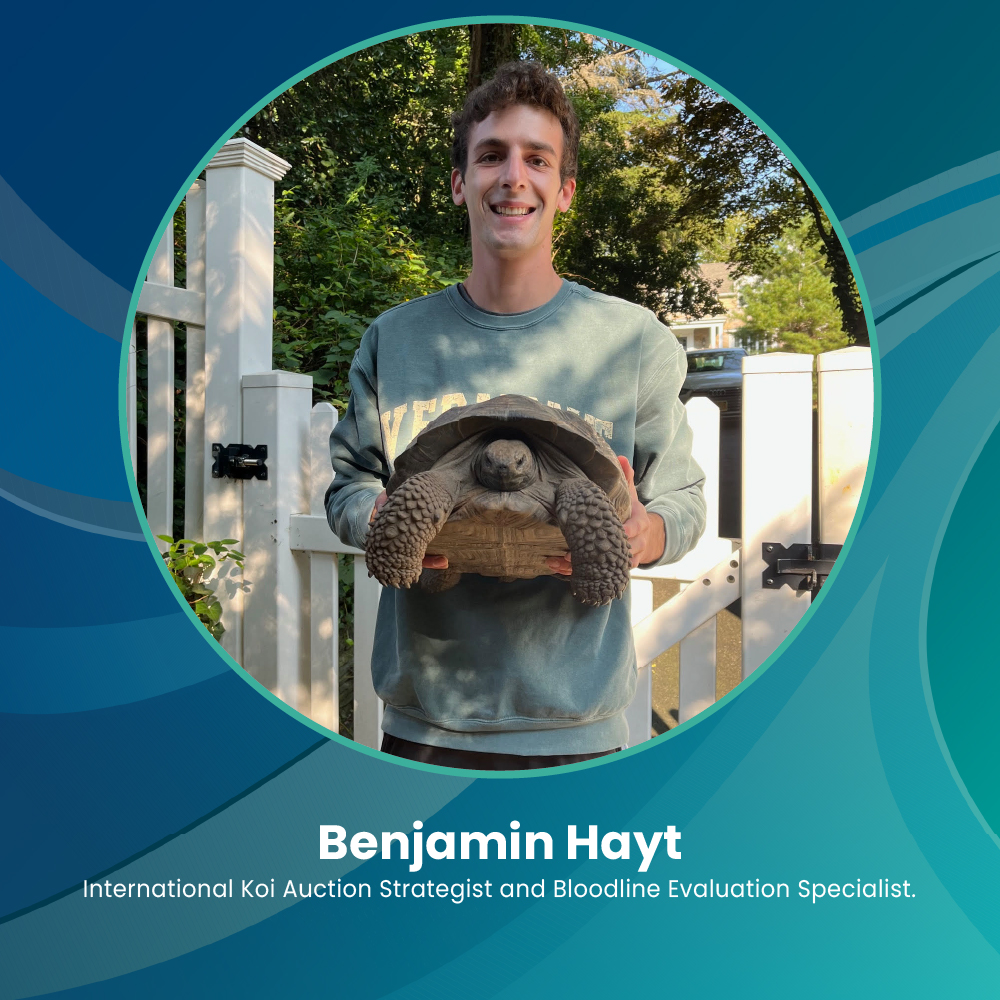
Benjamin’s experience extends further into exotic animal husbandry into the realm of rare chelonian species. Over the years, he has managed the care of Galápagos tortoises (Chelonoidis nigra), radiated tortoises (Astrochelys radiata), and Sri Lankan star tortoises (Geochelone elegans). Again, these accomplishments attest to his skills and knowledge in environmental calibration and enclosure design. For Benjamin Hayt, Chelonian management at this level is more than a casual pursuit. Beyond the ornamental aspect, he demonstrates a genuine passion for structured habitat planning and ongoing assessment of growth, shell development, and metabolic health.
A Multidisciplinary Focus
Benjamin Hayt’s work spans laboratory research, aquatic systems design, and long-term animal stewardship. While his graduate studies center on marine invertebrate cell culture, much of his experience comes from managing and refining complex living systems over time.
Across research, koi development, and chelonian care, his approach remains consistent: careful observation, incremental improvement, and disciplined maintenance of stable environments. Each area informs the others, reinforcing a practical understanding of how biological systems respond to controlled conditions.
Rather than emphasizing rapid breakthroughs, Ben Hayt’s work reflects a steady commitment to technical refinement and long-term results.
Portfolio
Ben Hayt